



Games of Warhammer 40,000 are great fun, but if you’ve never tied them together into a sprawling narrative campaign filled with drama, emergent stories, and unexpected outcomes, you owe it to yourself to try. An average Saturday afternoon brawl becomes one part of a gripping map-based campaign, where the balance of power flows back and forth, and great heroes rise to lead veteran armies upgraded over the course of the story.
It might all sound quite complicated, but that couldn’t be further from the truth, and everything you need to start a remarkable campaign of your own can soon be found in the 500 Worlds: Titus – War on the Vespator Front book.
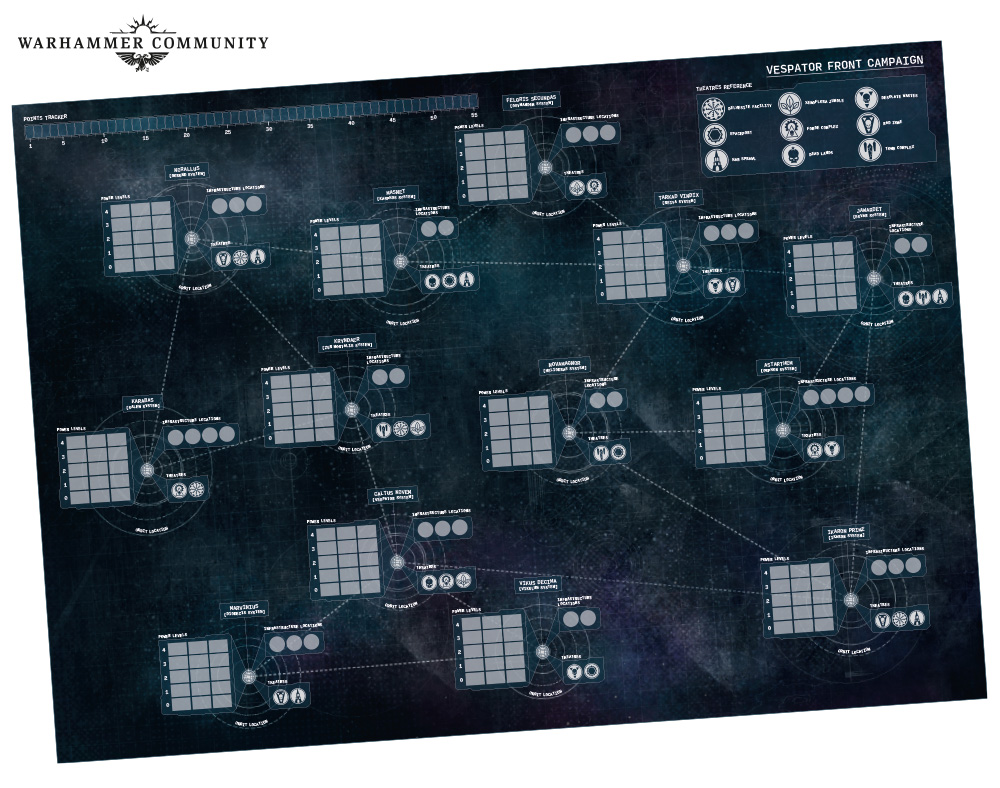
We’ll start, as grand campaigns tend to do, with a map. The 500 Worlds: Titus set comes with a large fold-out campaign map to get you started, which is the perfect rallying point for your players when hung on a wall or spread across a table. Here you’ll see all of the systems you’ll be fighting across in a typical Vespator Front campaign*, with all sorts of boxes to fill in with information as the story progresses.
Competing to control as many systems as possible by the end of the campaign period will be three Alliances, which can have whatever motivations for working together they like – such as Imperial, Chaos, and xenos factions banding together along factional lines, or three groups manipulated by the Ordo Malleus, Ordo Xenos, and Ordo Hereticus fighting for unknowable reasons. Whatever makes the most sense for your group is alright by us.
Don’t worry if your local group can only support two Alliances, or only one or two people per team – it’s all accounted for.
Each Alliance will do far more than simply fight for a common cause, as planets need to have infrastructure built upon them, while attacking and defensive battles must be assigned to those best placed to fight them. All of these operations are tracked on the map itself, and you even get a full sticker sheet with all the markers you need so you don’t have to go drawing all over it straight away.
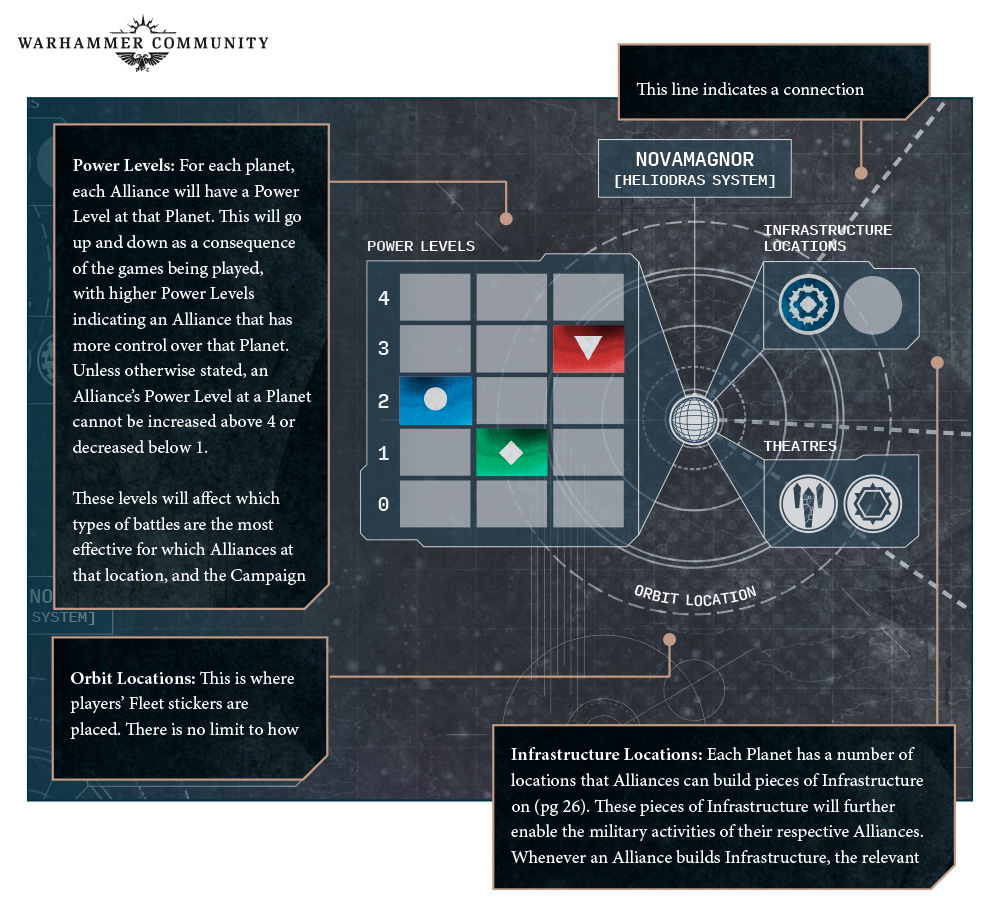
Power Levels: For each planet, each Alliance will have a Power Level at that Planet. This will go up and down as a consequence of the games being played, with higher Power Levels indicating an Alliance that has more control over that Planet. Unless otherwise stated, an Alliance’s Power Level at a Planet cannot be increased above 4 or decreased below 1.
These levels will affect which types of battles are the most effective for which Alliances at that location, and the Campaign Outcomes that each battle results in. Each Alliance has a Power Level sticker that can be placed at the Planet to indicate its value.
Orbit Locations: This is where players’ Fleet stickers are placed. There is no limit to how many Fleets can be in orbit at each Planet.
This line indicates a connection between two Planets.
Infrastructure Locations: Each Planet has a number of locations that Alliances can build pieces of Infrastructure on. These pieces of Infrastructure will further enable the military activities of their respective Alliances. Whenever an Alliance builds Infrastructure, the relevant sticker will be placed on one of these unused spaces.
In each Campaign phase, your fleet will choose from a number of Operations that might see them attacking a neighbouring planet, moving to a more advantageous location, building infrastructure, or sabotaging an opposing Alliance’s control over a planet. In this way, players that might not have time to play a game in that phase can still contribute to their Alliance’s overall progress.
Naturally, attacking your opponents and playing games of Warhammer 40,000 is the best way to progress in the campaign, and there’s much more to do than simply throwing down some models and having at it. Each planet has a number of Theatres that the aggressor can choose to assault, which carry their own twists for the upcoming battle as well as offering recommended terrain to keep things thematic.**
The Xenoflora Jungle, for instance, might blanket the battlefield in rage-inducing spores or be so choked with vegetation that units can’t Fire Overwatch, giving melee-oriented armies a particular advantage.
XENOFLORA JUNGLE
From temperate forest to seething jungle, regions overrun with alien undergrowth present a close and hazardous environment in which to do battle.
Tactical Benefits: These Twists provide a boost to melee‑orientated armies, contributing improved damage dealing, protection from Overwatch and punishment of units that Fall Back.
Recommended Terrain: For this Theatre, we recommend using a mixture of woods and ruins to represent a largely forested region dotted with the remains of overgrown structures. There should be a large number of such terrain features scattered fairly equally across the battlefield, to reflect the sheer density of the area’s flora.
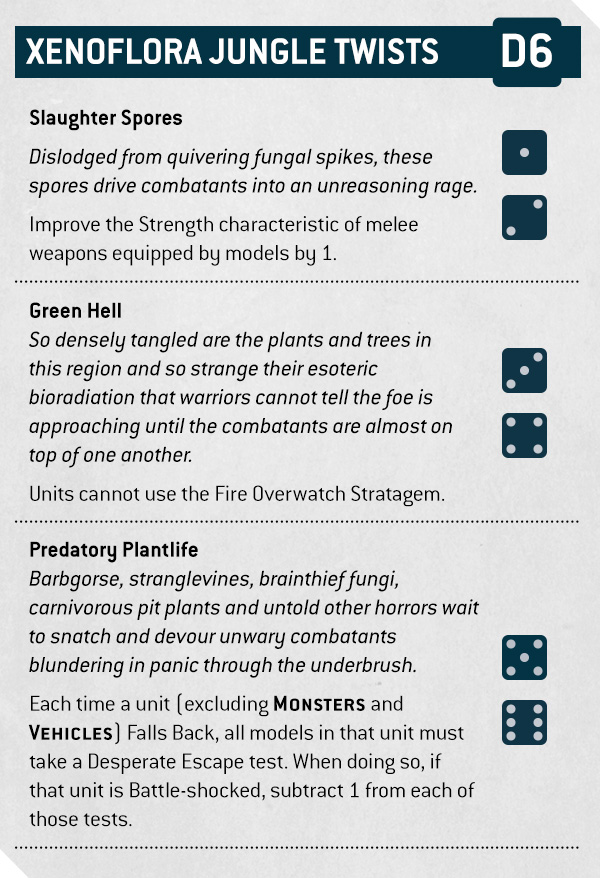
XENOFLORA JUNGLE TWISTS
Slaughter Spores
Dislodged from quivering fungal spikes, these spores drive combatants into an unreasoning rage.
Improve the Strength characteristic of melee weapons equipped by models by 1.
Green Hell
So densely tangled are the plants and trees in this region and so strange their esoteric bioradiation that warriors cannot tell the foe is approaching until the combatants are almost on top of one another.
Units cannot use the Fire Overwatch Stratagem.
Predatory Plantlife
Barbgorse, stranglevines, brainthief fungi, carnivorous pit plants and untold other horrors wait to snatch and devour unwary combatants blundering in panic through the underbrush.
Each time a unit (excluding Monsters and Vehicles) Falls Back, all models in that unit must take a Desperate Escape test. When doing so, if that unit is Battle‑shocked, subtract 1 from each of those tests.
Unlike Matched Play games using the Chapter Approved mission pack, the objectives in any given battle are decided by the player launching the attacking Operation, with each type of attack corresponding to one of the five new missions in the War on the Vespator Front book or the Boarding Actions rules from the Dread Incursions book.
You may decide to launch an Orbital Invasion, in which your army thunders down into the centre of the board and holds its objectives from the outset – forcing the Defenders to surround your landing zone and reclaim their territory. Having a greater level of control over the planet means that more of your units can Deep Strike, which will be a vital way to reinforce the forces on the ground who will quickly be beset from all sides.
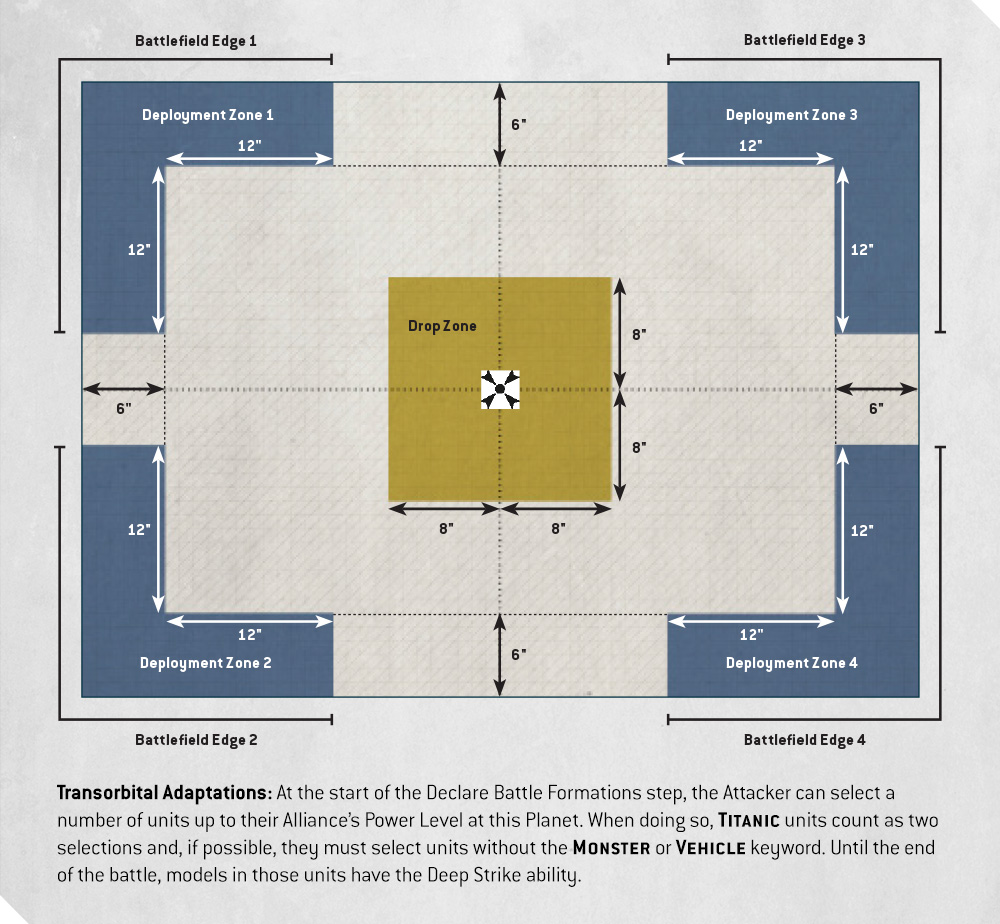
Transorbital Adaptations: At the start of the Declare Battle Formations step, the Attacker can select a number of units up to their Alliance’s Power Level at this Planet. When doing so, Titanic units count as two selections and, if possible, they must select units without the Monster or Vehicle keyword. Until the end of the battle, models in those units have the Deep Strike ability.
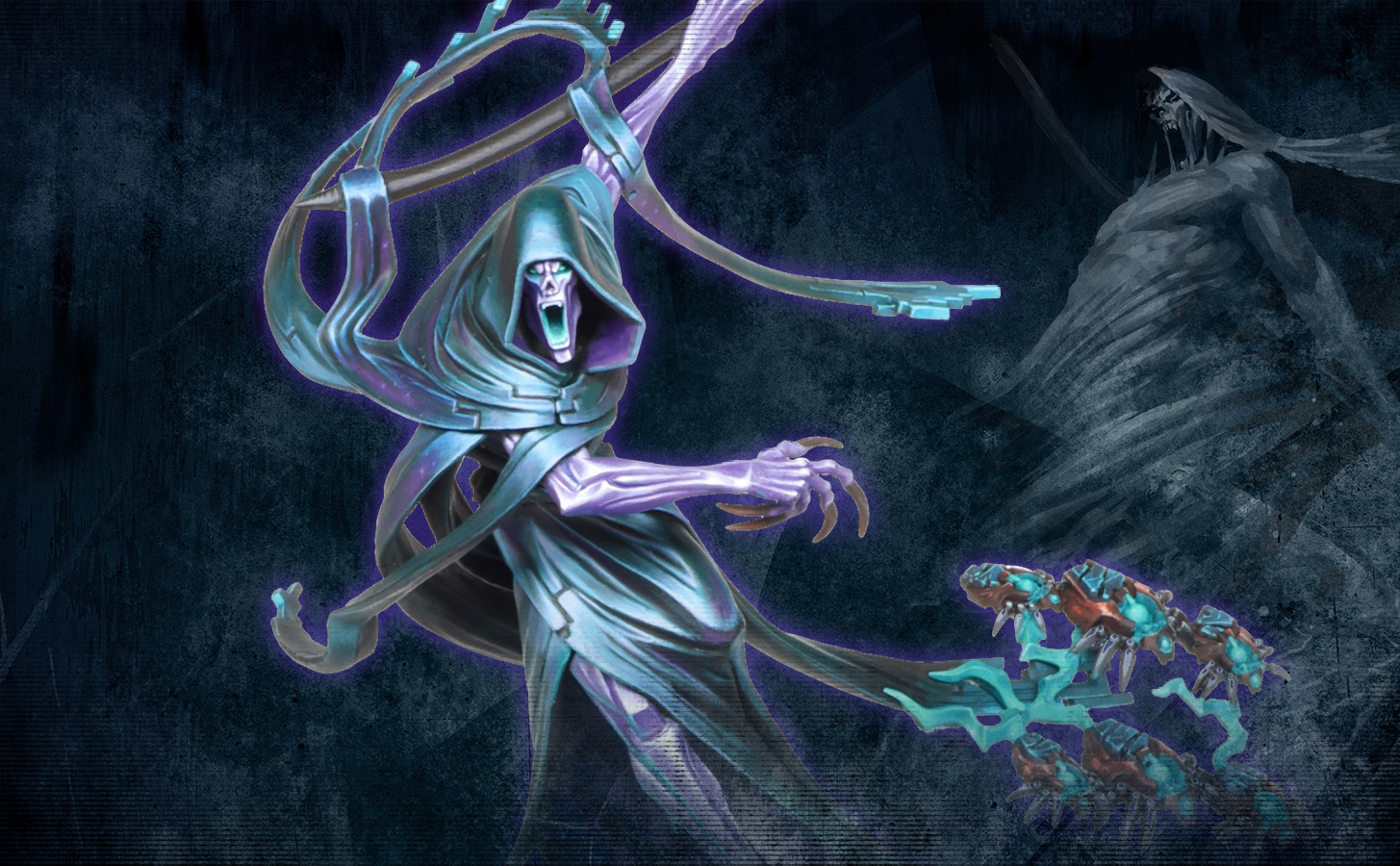
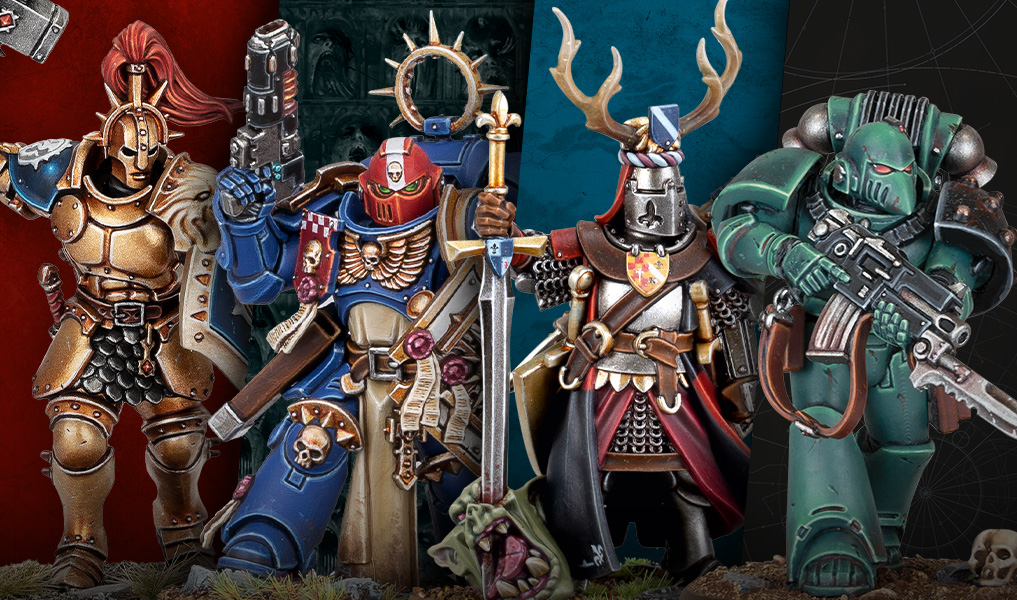
Launch a campaign to conquer the Vespator Front when the 500 Worlds: Titus set goes up for pre-order this Saturday, alongside the new Captain Titus and the delightfully terrifying Nekrosor Ammentar.
* The planets named are from the Vespator Front in Ultramar, but feel free to come up with your own for different sectors of the galaxy.
** Though you’re free to play with whatever you have available.