



Today we’re looking at how the focus you choose for your army will affect the missions your force is sent on in the new edition of Warhammer 40,000.
Earlier this week, we learned how new army building rules give you a wider choice of Detachments to pick for your force. Each Detachment will now give you one or more Force Dispositions, which are generally tied to how that force would perform in battle.
In earlier mission packs, the way you built your army had no impact on the missions the game asked you to complete. Khorne Berzerkers might inexplicably race to stand on objectives in the corners of battlefields, or Tau Fire Warriors might find themselves assaulting entrenched melee units to secure a few extra Victory Points. The new missions encourage you to complete the sorts of objectives your army would naturally pursue.
When you build your army, your Detachments each unlock a different Force Disposition, one of which you will choose to represent your army's Force Disposition for each battle. This establishes the broad mission your army would likely be assigned to accomplish. Like any good general, however, you'll determine the manner in which you achieve that mission based upon real battlefield conditions on the ground. By comparing your chosen Force Disposition to your opponent's at the start of the battle, you find out the specific details of the mission you'll be playing.
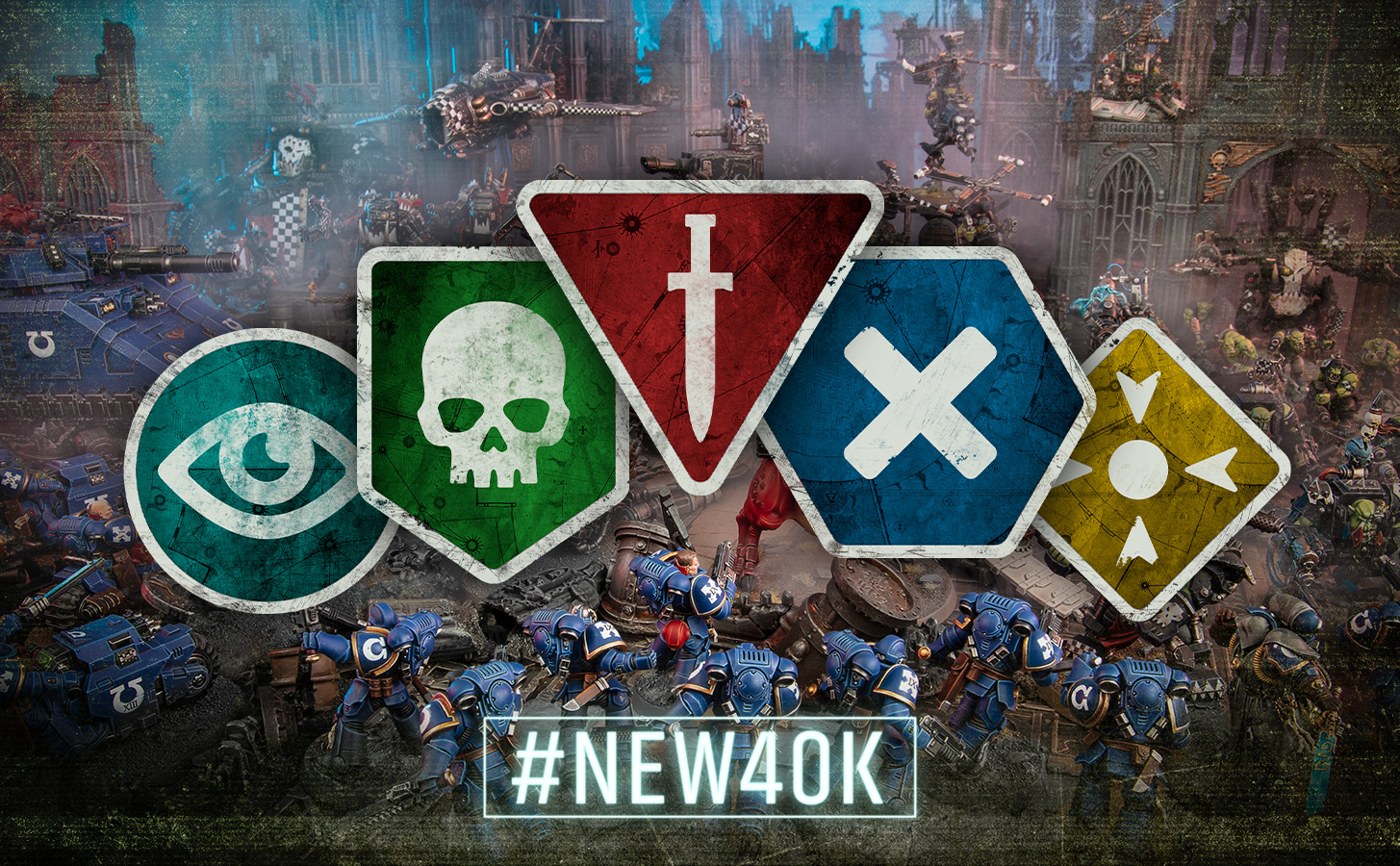
There are five Force Dispositions in total: Take and Hold, Purge the Foe, Disruption, Reconnaissance, and Priority Assets.
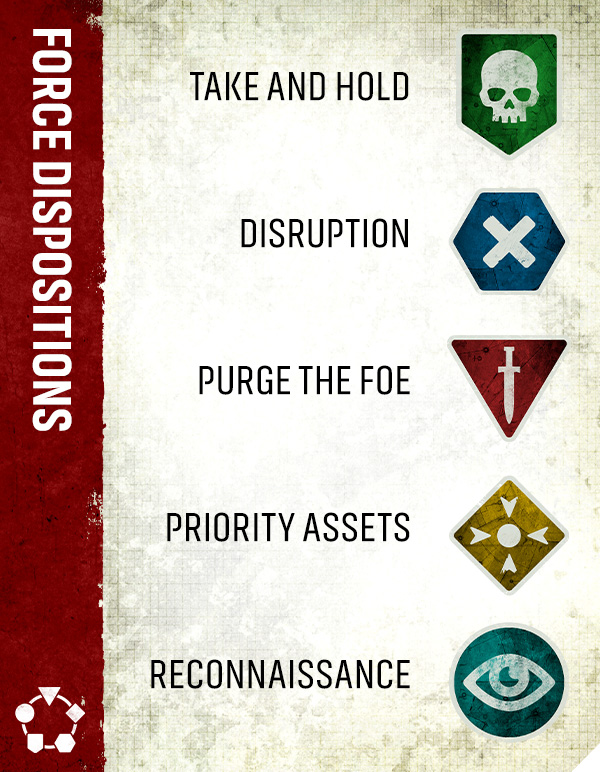
Force Dispositions
Take and Hold
Disruption
Purge the Foe
Priority Assets
Reconnaissance
Each Force Disposition is geared towards thematic mission objectives, so an army choosing Purge the Foe will often score Victory Points for wiping out enemy units, while one opting for Disruption might need to perform actions in enemy territory or while occupying crucial areas of terrain.*
While missions are designed to create a narrative in every game, they're still tightly balanced around each other: asymmetrical in nature, but still fair, telling an authentic Warhammer story between two well-matched forces.
Almost all will still score some measure of points for holding objectives on the battlefield, so you can’t completely abandon board control for carnage, but the exact split will vary.
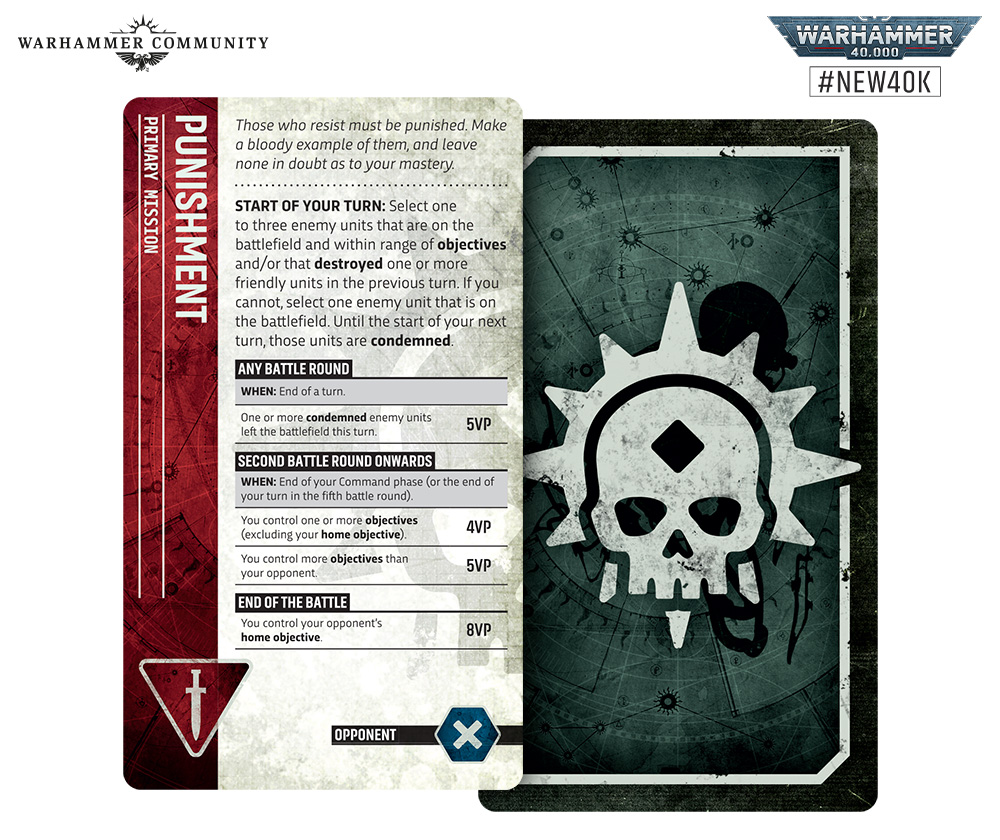
The Primary Mission for a Purge The Foe force taking on a Disruption opponent
This does mean that – unless you both pick the same Force Disposition – you and your opponent will have different primary objectives, creating a fun tactical challenge that writes its own story.** You’re not just shooting some Orks to pieces – you’re stopping some sneaky Blood Axes from booby trapping your frontline fortifications.
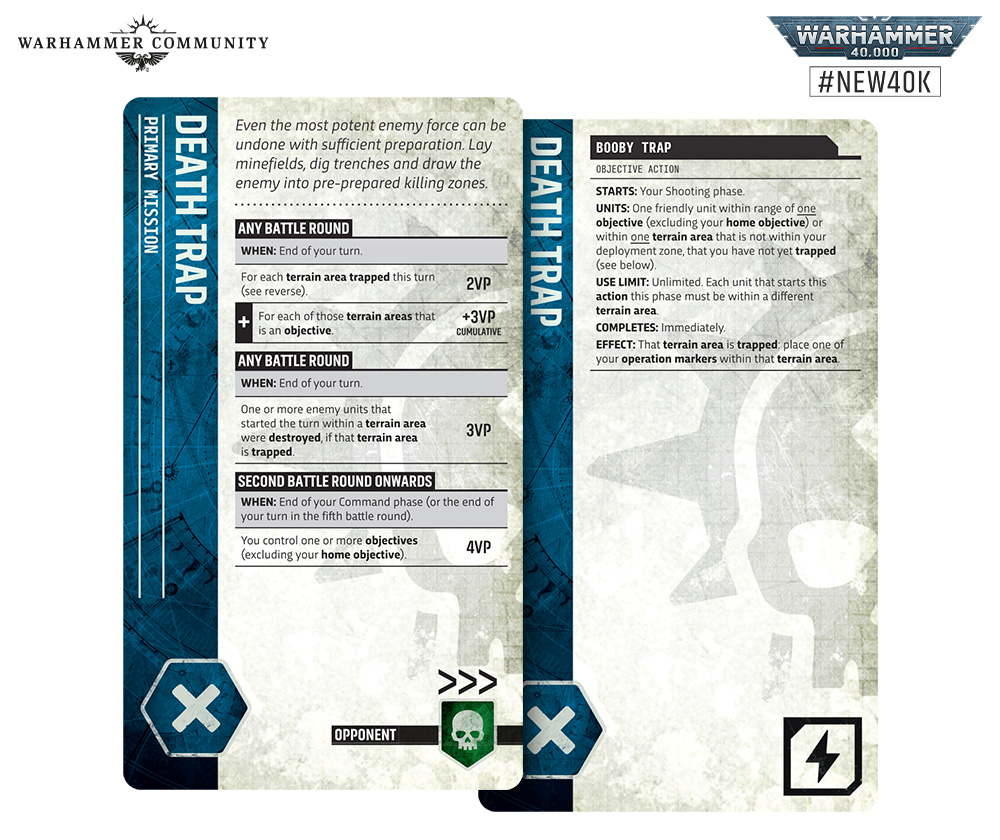
The Primary Mission for a Disruption force taking on a Take and Hold opponent
In pickup games, you can choose a different Force Disposition ahead of each battle. In a tournament setting, you'll usually lock your Force Disposition for the event when you submit your list. Since each Force Disposition has 5 distinct missions (one for each other Force Disposition), you can therefore control the level of complexity in terms of what mission rules and combinations you need to learn.
The rest of the pre-game sequence follows a similar route to the one you’re used to in the current edition.
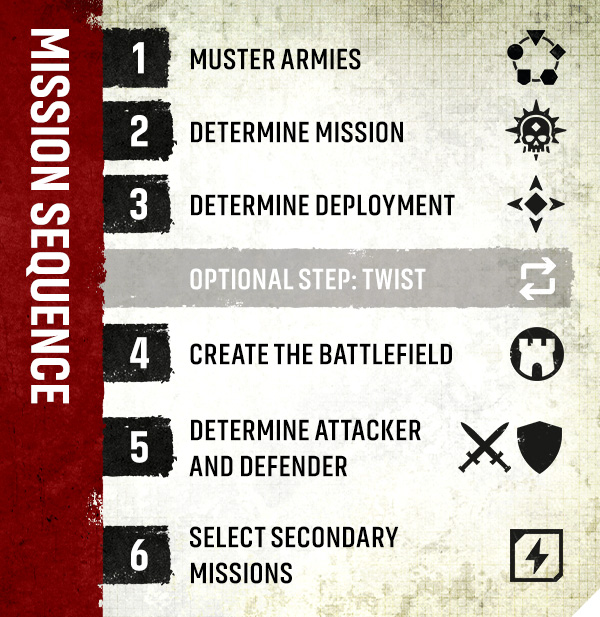
Mission Sequence
1: Muster armies
2: Determine mission
3: Determine deployment
Optional step: Twist
4: Create the battlefield
5: Determine attacker and defender
6: Select secondary missions
Deployment cards will be familiar to existing players, featuring classic set-ups such as Dawn of War, Hammer and Anvil, and Tipping Point. Each mission pairing also has three recommended terrain layouts using specific deployments designed to give both players a balanced battlefield to fight through, though you’re always free to come up with your own too, to match your own terrain collection.
Secondary objectives return much the same as they are in the current edition, allowing players to choose Fixed or Tactical objectives to either stick with their favourites or draw cards from a deck for a chance at higher scoring.
Tactical objectives have one big change though – instead of only having two at any given time, now you’ll draw two objective cards every turn and keep hold of the ones you haven’t scored yet, so you don’t need to worry about an early draw scuppering your late-game plans.
It’s worth noting that each Primary Mission has a total cap of 45VP per game, and a cap of 15VP per battle round, with the same for Secondary Missions. So you can’t wait and try to score everything right at the end!
Finally, Twists also return as an optional mechanic that can modify core rules or introduce unexpected challenges – one can allow all units to move through terrain like nimble infantry, while another causes both players to completely swap their primary objectives for extra chaos!
All of the initial mission rules and deployment cards come in the new Chapter Approved mission deck, which will be included inside the Armageddon launch box alongside another mystery deck that we’ll talk more about soon.
Over the next week, we'll discuss the now tightly-connected concepts of army construction, mission, objectives, and terrain, and how New40K creates the best opportunity yet for telling awesome stories whilst engaging in tightly contested battles across the nightmare landscapes of the 41st Millennium.
* Got questions about terrain and objectives? Stay turned to Warhammer Community next week where we’ll be looking closer at this section of the rules.
** There’s even an optional Twist – Mirrored World – that lets you ditch this, and both use the same primary for when you’re in the mood for a more symmetrical game.