

The new General’s Handbook goes on pre-order tomorrow! We asked Ryan from Threshold Tactics for some thoughts on what to expect from the new season of Warhammer Age of Sigmar.
Ryan: The new General’s Handbook takes us on a journey through the Stormrift Realmgate, saying farewell to our season in wooded Ghyran. Our tenure in fiery Aqshy brings much more than just a change of scenery – along with new season rules come new battle tactics and new fields of battle in the form of 12 new battleplans to help flesh out the ongoing narrative of the Mortal Realms.
There’s too much to cover in just one Warhammer Community article, so I’m going to lean into a more competitively-oriented take on the new rules – aspects I’m particularly looking forward to, elements I believe the meta will latch onto, and challenging new puzzles to be solved by the community at large by running the gauntlet again and again in the punishing Realm of Fire.
Rage and fury
The new Season Rules come down to two mechanics – fury level and rage dice. Your fury level, which is capped at 7, helps determine how many rage dice you have available to you, but there are a number of interactions that can raise or lower this level, along with other ways to spend and accumulate your rage dice. As we saw when the General’s Handbook was revealed, your rage dice revolve largely around either an Eruption of Fury from one of your units in combat at the end of any turn, to allow them to keep the fight going (potentially inflicting mortal damage on every enemy unit within 3”, not just the target of their attacks!), or the defensive Fight Through the Pain, giving your warriors the Tzeentch-like ability of shrugging off damage that would otherwise be allocated to them (at the cost of lowering your fury level).
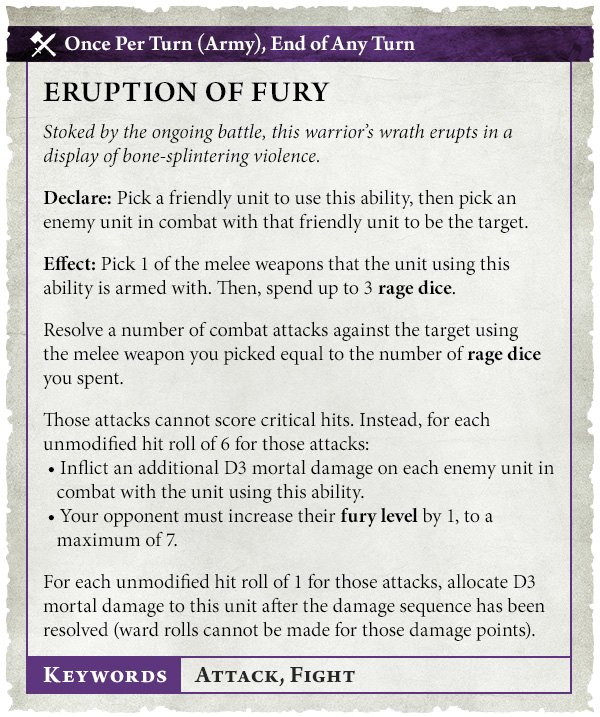
Eruption of Fury
Once Per Turn (Army), End of Any Turn
Stoked by the ongoing battle, this warrior’s wrath erupts in a display of bone-splintering violence.
Declare: Pick a friendly unit to use this ability, then pick an enemy unit in combat with that friendly unit to be the target.
Effect: Pick 1 of the melee weapons that the unit using this ability is armed with. Then, spend up to 3 rage dice.
Resolve a number of combat attacks against the target using the melee weapon you picked equal to the number of rage dice you spent.
Those attacks cannot score critical hits. Instead, for each unmodified hit roll of 6 for those attacks:
Inflict an additional D3 mortal damage on each enemy unit in combat with the unit using this ability.
Your opponent must increase their fury level by 1, to a maximum of 7.
For each unmodified hit roll of 1 for those attacks, allocate D3 mortal damage to this unit after the damage sequence has been resolved (ward rolls cannot be made for those damage points).
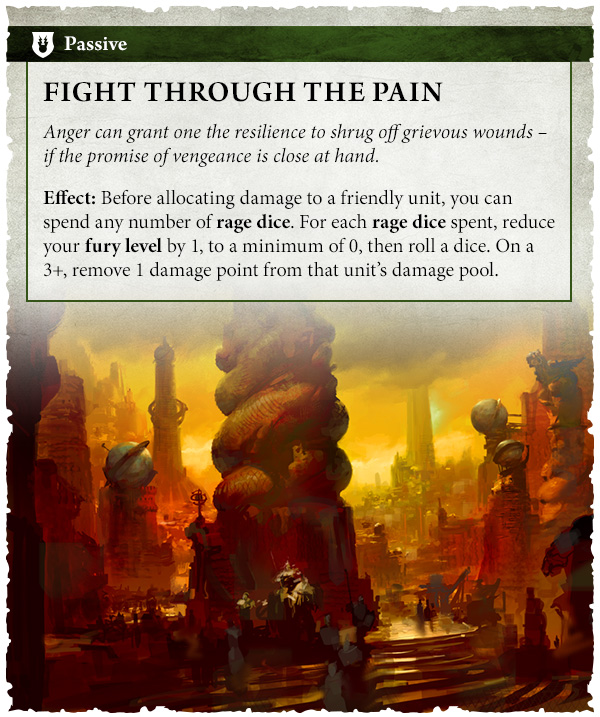
Fight Through the Pain
Passive
Anger can grant one the resilience to shrug off grievous wounds – if the promise of vengeance is close at hand.
Effect: Before allocating damage to a friendly unit, you can spend any number of rage dice. For each rage dice spent, reduce your fury level by 1, to a minimum of 0, then roll a dice. On a 3+, remove 1 damage point from that unit’s damage pool.
This leads to a dance you and your opponent will be performing throughout each battle. Imagine that your opponent is trying to score Master of Arms to start their Blazing Onslaught battle tactics card by allocating damage to one of your units in three or more phases that turn, but that you can deny this by rolling a couple of 3-ups on rage dice to fight through the pain.
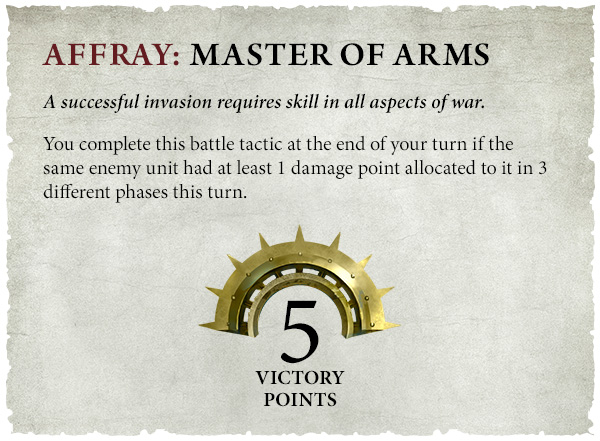
AFFRAY: Master of Arms (5 VPs)
A successful invasion requires skill in all aspects of war.
You complete this battle tactic at the end of your turn if the same enemy unit had at least 1 damage point allocated to it in 3 different phases this turn.
Conversely, if you’ve already fulfilled those requirements in the shooting and combat phases but are fresh out of command points to deliver a punishing Power Through to do some extra damage in the End of Turn, an Eruption of Fury is likely your last chance this turn at scoring that tactic and setting yourself up for the other two tactics on that card in the coming rounds.
If you need more rage dice, you can tap into the reforged rules for Places of Power, specifically Ignite Fury, which allows you to accumulate up to 11 rage dice, assuming you keep hoarding them until the bottom of the battle round. The temptation of using this ability instead of boosting your casting/chanting potential or giving yourself an extra unbind/banish might be enough to have at least one Hero constantly keeping watch over their favourite Place of Power for the rest of the game, despite the potential downside of taking D3 mortal damage in the attempt.
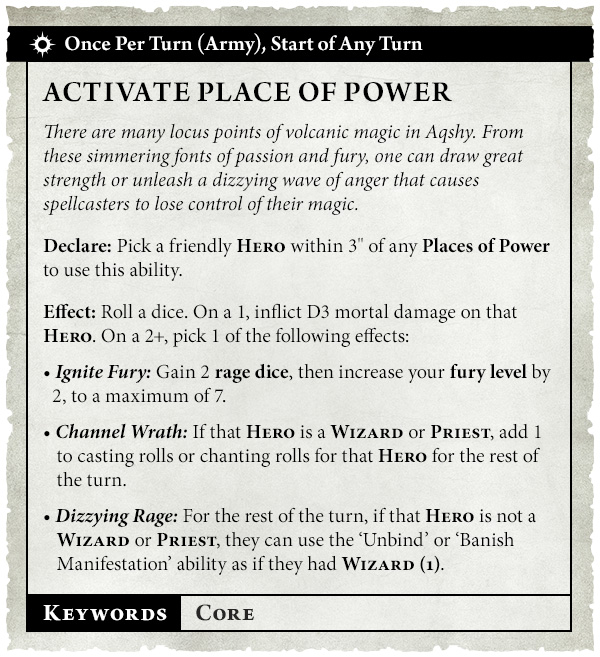
Activate Place of Power
Once Per Turn (Army), Start of Any Turn
There are many locus points of volcanic magic in Aqshy. From these simmering fonts of passion and fury, one can draw great strength or unleash a dizzying wave of anger that causes spellcasters to lose control of their magic.
Declare: Pick a friendly HERO within 3" of any Places of Power to use this ability.
Effect: Roll a dice. On a 1, inflict D3 mortal damage on that HERO. On a 2+, pick 1 of the following effects:
• Ignite Fury: Gain 2 rage dice, then increase your fury level by 2, to a maximum of 7.
• Channel Wrath: If that HERO is a WIZARD or PRIEST, add 1to casting rolls or chanting rolls for that Hero for the rest of the turn.
• Dizzying Rage: For the rest of the turn, if that HERO is not a WIZARD or PRIEST, they can use the ‘Unbind’ or ‘Banish Manifestation’ ability as if they had WIZARD (1).
Nowhere to hide
Shooting and magic fans rejoice, for gone are the days of almost everything on the table potentially being obscuring. In a subtle but VERY impactful change via the new terrain 2026-27 rules, Places of Power and Area Terrain no longer generate the obscuring terrain ability. As you saw in the Place of Power rules above, cunning Heroes nearby no longer have the ability to make objectives and terrain features obscuring. This leaves our battleplan maps with as few as two small wooded areas around which to hide from the more shooting and magic-inclined armies. Granted, there are plenty of maps with up to three large obscuring pieces and one small one (or two of each), but the fact that that’s all that your opponent (or you, to be fair) is going to get might have a serious impact on the meta. And don’t forget that just because a terrain piece looks like woods on the battleplan map doesn’t necessarily mean it has to be flat enough to walk through, meaning your units might have to hug the perimeter of the woods to get obscuring, so don’t count on those four woods as all being places to hide!
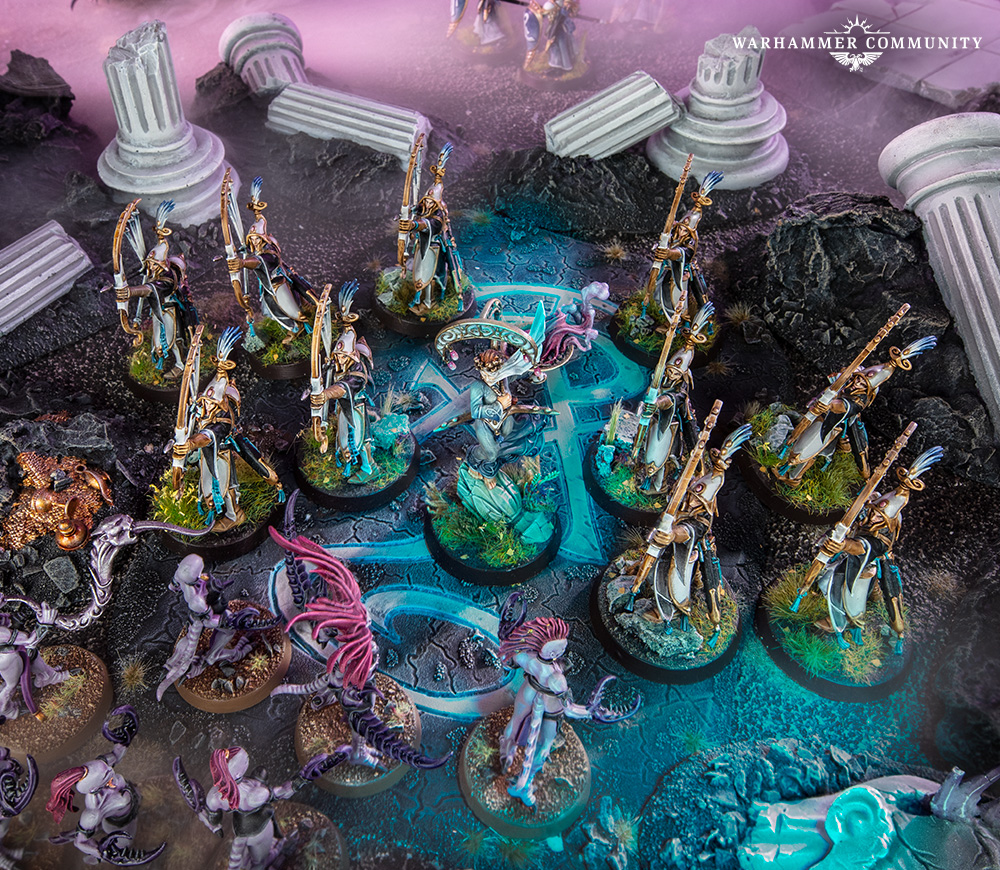
For those mourning the loss of limited visibility, I’ll go ahead and prematurely cheer you up with the battleplan Hidden Under Ash-Clouds, which, in addition to perhaps being the most thematic of the 12 new missions, has a new mechanic built entirely around limiting visibility (and movement) in the neutral centre of the battlefield.
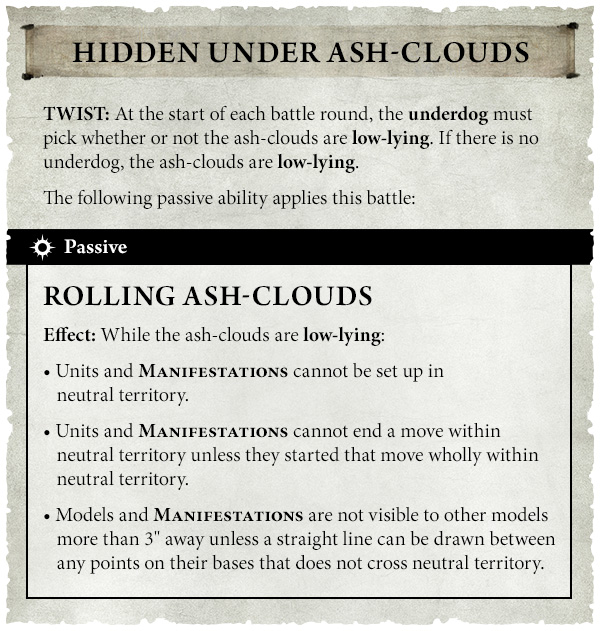
Hidden Under Ash-clouds
Twist: At the start of each battle round, the underdog must pick whether or not the ash‑clouds are low-lying. If there is no underdog, the ash-clouds are low-lying.
The following passive ability applies this battle:
Rolling Ash-clouds
Passive
Effect: While the ash-clouds are low-lying:
• Units and MANIFESTATIONS cannot be set up in neutral territory.
• Units and MANIFESTATIONS cannot end a move within neutral territory unless they started that move wholly within neutral territory.
• Models and MANIFESTATIONS are not visible to other models more than 3" away unless a straight line can be drawn between any points on their bases that does not cross neutral territory.
I can already imagine conniving generals quickly moving their entire forces into the centre and doing their best to stay the underdog (or let it remain a tied game) so as to guarantee that the centre remains under the ash-clouds. Meanwhile, their army will be preparing to take control of all five objectives while simultaneously staying safe from being targeted by anything but melee attacks, all until their perfect moment presents itself to lay down the fatal blow on their opponent.
One final, extremely impactful change in the terrain module for the season is that faction terrain can no longer be charged unless it is garrisoned. Perhaps the molten landscape has heated up not only the ground but the architecture thereon, but I have a strong feeling this seemingly innocuous change might actually be one of the favourites for seasoned players. We’ve often been wary of even deploying them for fear that we were just giving our opponents a charging launchpad to get immediately into the fray “for free.” You can still fight that terrain piece if you walk or even run up to within combat range of it, but at least you’re not getting a whole lot of extra movement off my precious, relatively defenceless terrain piece. It’s not only a quality-of-life improvement strategically, but also for the hobby, as I expect we'll see a few more beautifully painted terrain pieces at tournaments to help establish the theme and spirit of your army.
Spitfire secondaries
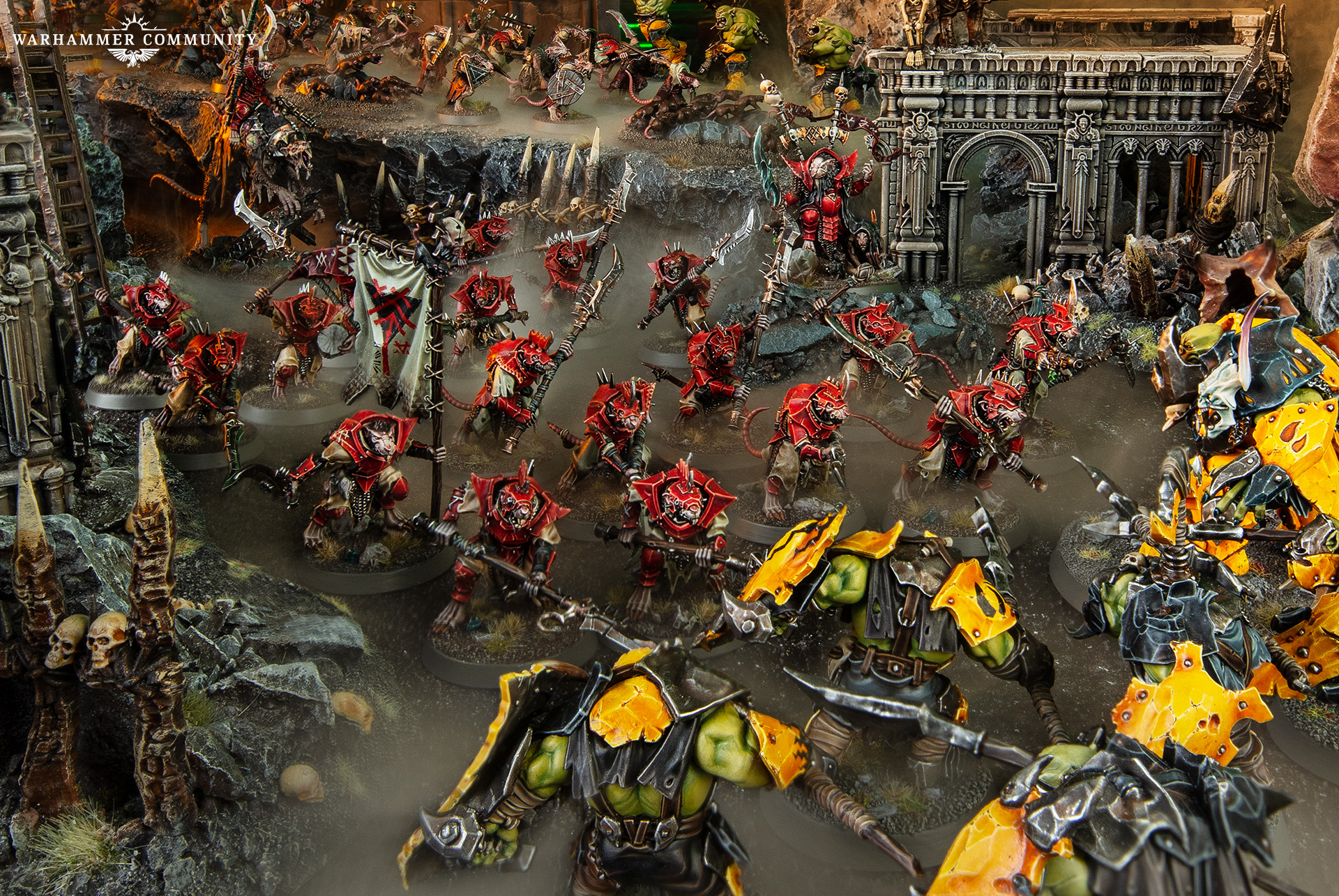
Over the past year, we’ve all gotten accustomed to the new battle tactics system of choosing, at the list building step, two cards’ worth of tactics that synergise well with your army and then trying to sequentially tick off as many of your objectives as possible in the sanctioned order of Affray, then Strike, then Domination. One of the most interesting aspects of this system has been seeing how difficult it often can be to actually progress up these cards, especially when your opponent is doing their best to stop you from doing so. By the end of this past season in Ghyran, I feel that players had worked out realistic expectations of what they reasonably could accomplish in specific matchups on specific missions, and though the new season doesn’t shake up the system itself that much, what we will have to adapt to are the totally new set of battle tactics mechanics for scoring your secondary points.
Of the six new options available, two require extra choices to be made before the battle commences – Blazing Onslaught has your opponent designating which of their terrain pieces will function as their army’s hideout, while Burning for Vengeance has you choosing an enemy Hero to be a fugitive that you essentially have to round up.
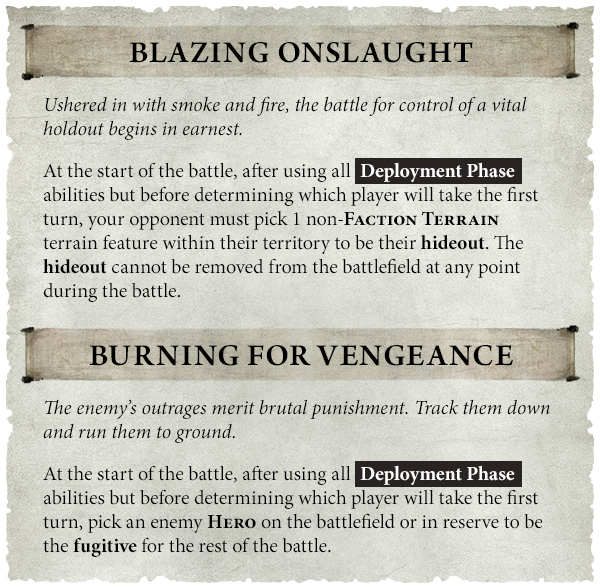
Blazing Onslaught
Ushered in with smoke and fire, the battle for control of a vital holdout begins in earnest.
At the start of the battle, after using all Deployment Phase abilities but before determining which player will take the first turn, your opponent must pick 1 non-Faction Terrain terrain feature within their territory to be their hideout. The hideout cannot be removed from the battlefield at any point during the battle.
Burning For Vengeance
The enemy’s outrages merit brutal punishment. Track them down and run them to ground.
At the start of the battle, after using all Deployment Phase abilities but before determining which player will take the first turn, pick an enemy Hero on the battlefield or in reserve to be the fugitive for the rest of the battle.
What’s interesting to me about battle tactics in general is how much power you are inherently giving your opponent by committing to that set of side quests – by letting them choose a hideout, they may just do everything in their power to castle around that terrain piece as long as possible while still going about scoring their points. Or even when you’re “in control” by getting to choose their fugitive, who’s to stop them from just having them run away the whole game, potentially sending them up to reserve (looking at you, Tzeentch players), or treating the fugitive as the hideout and castling around them? This sort of push-pull dynamic really gets your gears going, trying to figure out what sort of trade-offs your army can afford with your choice of units, enhancements, and tactics.
Ashen wastelands
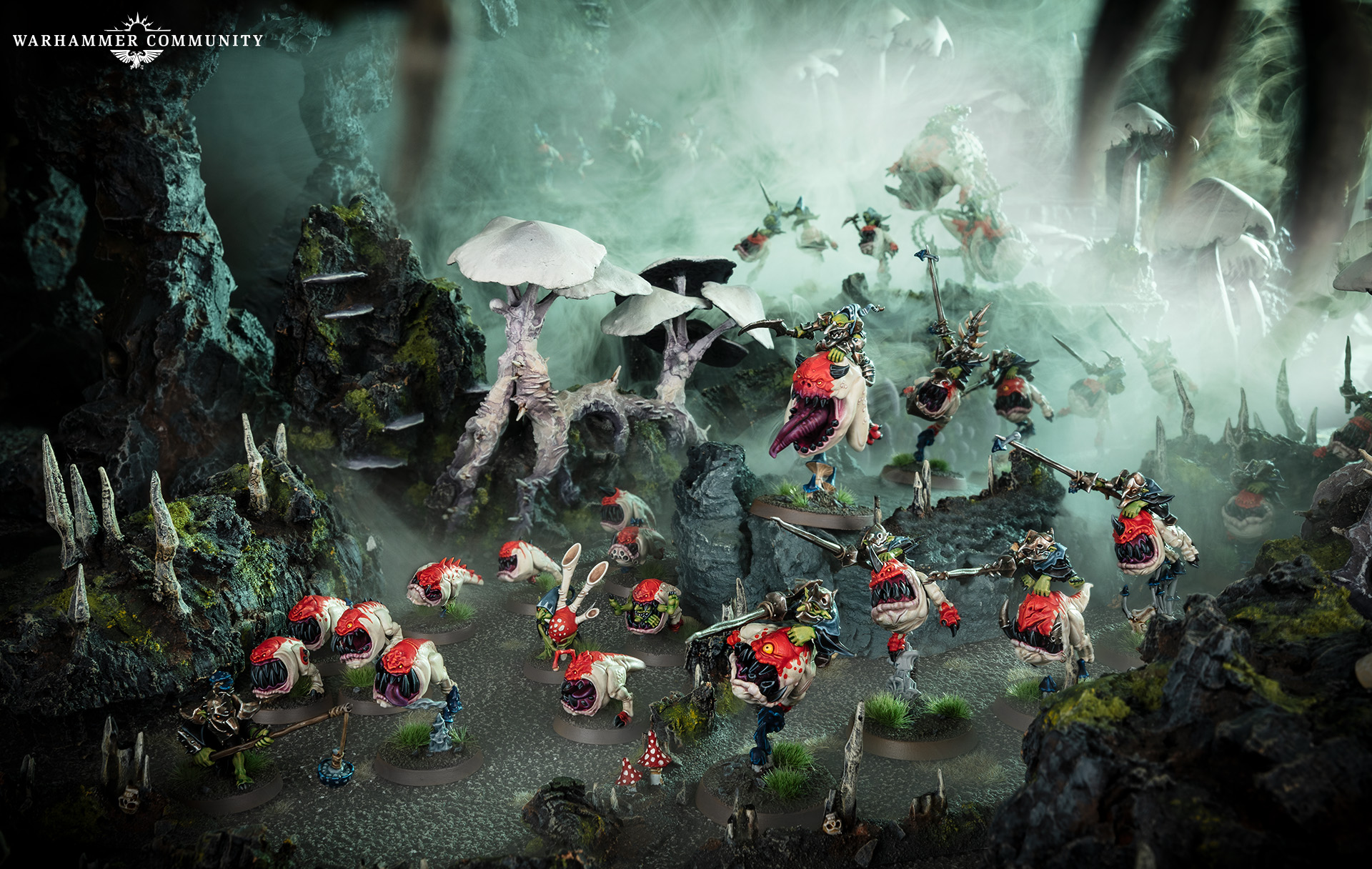
But really, what would a new General’s Handbook be without a newly branded set of thematic battleplans? Caverns of Slaughter simultaneously represents the smallest eligible deployment zone per player while also offering built-in teleporting through two terrain pieces chosen by the underdog to be the entrances to the titular caverns.
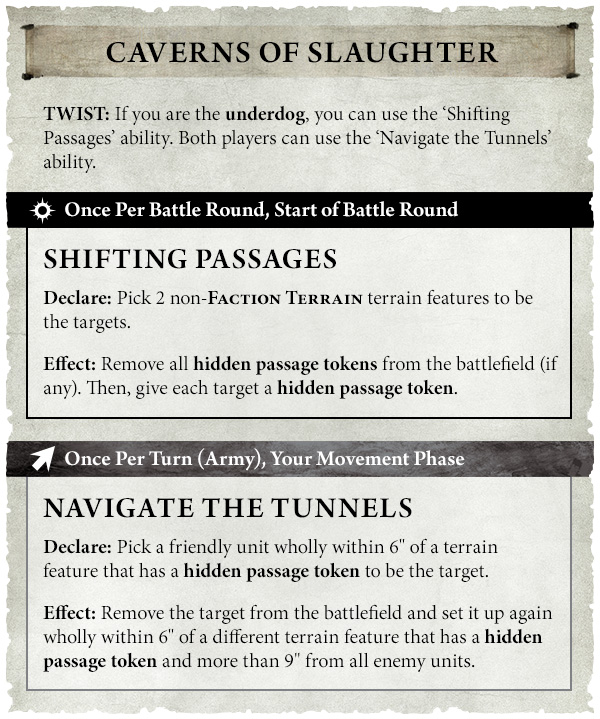
Caverns of Slaughter
Twist: If you are the underdog, you can use the ‘Shifting Passages’ ability. Both players can use the ‘Navigate the Tunnels’ ability.
Shifting Passages
Once Per Battle Round, Start of Battle Round
Declare: Pick 2 non-Faction Terrain terrain features to be the targets.
Effect: Remove all hidden passage tokens from the battlefield (if any). Then, give each target a hidden passage token.
Navigate the Tunnels
Once Per Turn (Army), Your Movement Phase
Declare: Pick a friendly unit wholly within 6" of a terrain feature that has a hidden passage token to be the target.
Effect: Remove the target from the battlefield and set it up again wholly within 6" of a different terrain feature that has a hidden passage token and more than 9" from all enemy units.
I can envision clever generals setting up advantageous teleporting lanes for their part of the battle round, while simultaneously setting up their opponents to either have nowhere to teleport to in their turn, or even better, setting a trap by having the enemy troops surrounded by theirs upon arrival. That said, playing along the longer length of the battlefield could really strain the deployment disadvantages certain army builds will face, either for getting across the table efficiently or for avoiding a first or second turn alpha strike by having to hang further back in their deployment zone.
While I can’t talk about all the new missions in detail, I will take a moment to point out a few trends. Firstly, a couple of the battleplans centre around a mechanic of steadily decreasing numbers of objectives to work with, perhaps the most interesting amongst them being Avalanche of Ash, which has increased odds of losing each of its six objectives as more units stand upon them. Another theme is having objectives or terrain features that do damage to your troops, as seen in Curse of the Gnaw.
Overall, aside from the strong tie-ins to Aqshian lore, from a purely game design perspective, many of these missions come across as brand-new concepts we haven’t yet encountered, with a handful of others as interesting twists on missions we’ve come to love. I’m particularly curious as to which missions become the staples of singles and teams tournaments as the season progresses, and which align best with different players and army builds.
Ultimately, I couldn’t possibly do the new General’s Handbook the justice it deserves with only a handful of hours steeped in the ashen innards of this fiery tome. I, too, will have to be forged in flame along with the rest of the community, and I’m excited to dive in as soon as possible!
Thanks, Ryan! Get ready for the new season of Warhammer Age of Sigmar with General’s Handbook 2026-27, which is available for pre-order tomorrow.